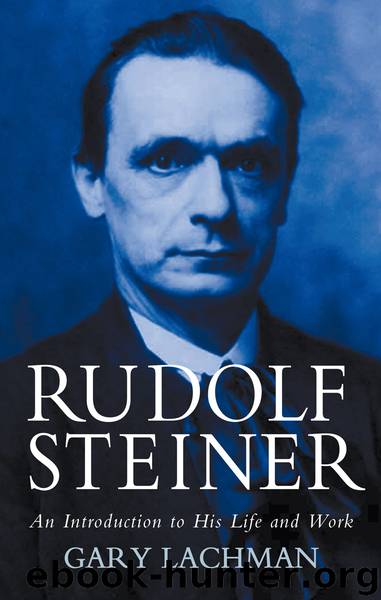
Rudolf Steiner: An Introduction to His Life and Work by Gary Lachman
Author:Gary Lachman [Lachman, Gary]
Language: eng
Format: epub
Publisher: Penguin Publishing Group
Published: 2017-02-14T05:00:00+00:00
7. THE RISE OF DR. STEINER
Although Annie Besant and the others who welcomed Steiner’s arrival saw him as a way of injecting new blood into the Theosophical Society, they soon realized with some chagrin that they were getting more than they had bargained for. It’s hackneyed to speak of a meteoric rise, but in Steiner’s case the phrase is apt. Upon becoming general secretary of the German section, Steiner swiftly rose to prominence and quickly established himself as a powerful and charismatic figure, a brilliant thinker with a mind of his own and no hesitations about using it. This sudden transformation from a respected but obscure scholar to a spiritual leader is reminiscent of some strange plant whose seed, dormant for years, had found its proper soil and immediately burst into rapid growth. It’s understandable that some members of the society were suspicious of his motives; they would have no difficulty agreeing with the historian of the occult James Webb, who remarked that “if we allow Steiner a consistency of aim and purpose, he cannot be acquitted of the charge of joining the theosophists with the intention of taking them over.”1 Steiner himself admits something of the sort when he says that he became involved in the Theosophical Society because it was only there that he discovered a suitable audience for his message. By all accounts, that audience grew rapidly, and one reason for the increasing friction between Steiner and his new associates was that, instead of becoming members of lodges in their own countries, which was the usual procedure, many new recruits joined the German section, simply because of Steiner. Although Steiner didn’t go out of his way to encourage this, it’s understandable that Annie Besant and other leading members would see in his popularity a dangerous rival to their own authority.
In the first few years, however, Annie decided that the best policy would be to try to heal any threatening rifts. In 1907 she wrote to an old-guard German member, Dr. Hübbe-Schleiden, who was unhappy with Steiner’s influence, assuring him that although different, Steiner’s vision and her own were compatible. “Dr. Steiner’s occult training,” she said, “is very different from our own. He does not know the eastern way, so cannot ... teach it. He teaches the Christian and Rosicrucian way, and this is very helpful to some, but is different from ours.... I regard him as a very fine teacher on his own lines, a man of real knowledge.”2 And in 1908, in an introduction to Steiner’s short book The Way of Initiation, Annie could write that “Dr. Steiner’s views ... are of great utility, supplying a side of Theosophical thought which might otherwise miss fitting recognition.”3 It may have been true, then, as some felt, that Steiner “gladly recognized the profound depth of Hindu wisdom and offered it a brotherly hand.”4 But nevertheless clouds were gathering, and it was only a matter of time before the storm broke.
Steiner himself may have been keeping his options open.
Download
This site does not store any files on its server. We only index and link to content provided by other sites. Please contact the content providers to delete copyright contents if any and email us, we'll remove relevant links or contents immediately.
Becoming Supernatural by Dr. Joe Dispenza(8217)
Crystal Healing for Women by Mariah K. Lyons(7930)
The Witchcraft of Salem Village by Shirley Jackson(7274)
Inner Engineering: A Yogi's Guide to Joy by Sadhguru(6794)
The Four Agreements by Don Miguel Ruiz(6765)
The Power of Now: A Guide to Spiritual Enlightenment by Eckhart Tolle(5781)
Secrets of Antigravity Propulsion: Tesla, UFOs, and Classified Aerospace Technology by Ph.D. Paul A. Laviolette(5371)
The Wisdom of Sundays by Oprah Winfrey(5161)
Room 212 by Kate Stewart(5120)
Pale Blue Dot by Carl Sagan(5008)
Fear by Osho(4740)
The David Icke Guide to the Global Conspiracy (and how to end it) by David Icke(4718)
Animal Frequency by Melissa Alvarez(4471)
Rising Strong by Brene Brown(4459)
How to Change Your Mind by Michael Pollan(4356)
Sigil Witchery by Laura Tempest Zakroff(4246)
Man and His Symbols by Carl Gustav Jung(4135)
The Art of Happiness by The Dalai Lama(4130)
Real Magic by Dean Radin PhD(4129)
